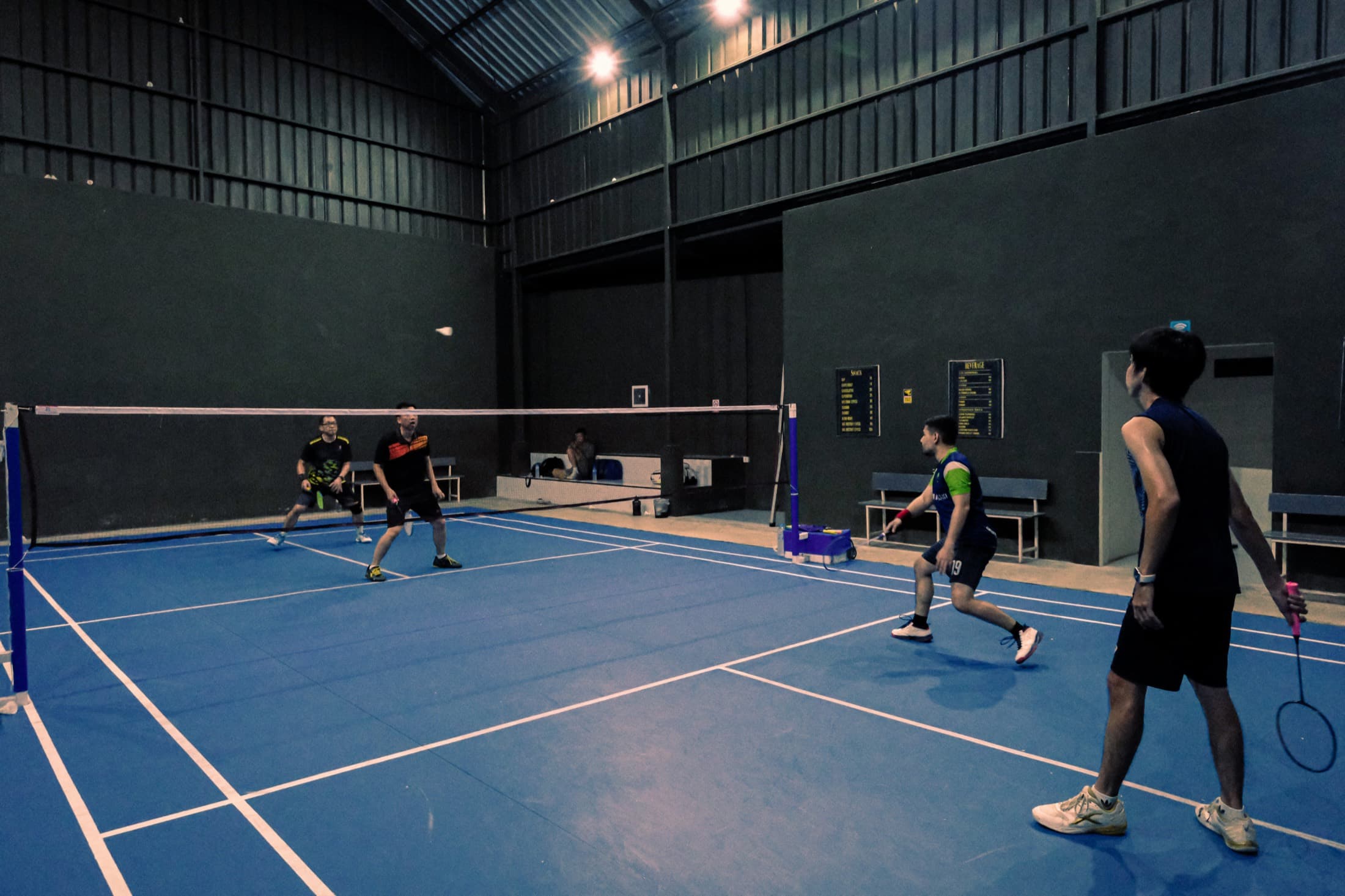
Match Up
How to run a doubles rotation at a club night
New partners and opponents every round, and whoever has played the fewest matches plays next. Extra players rest a round, in turn. In FinalPoint, Match Up builds each round inside a group's live session.
Updated 10 min read
At a glance
- The aim
- New partners and opponents every round
- Players per court
- 4 in doubles, 2 in singles
- Who plays next
- Whoever has played the fewest matches
- Spare players
- Extra players rest a round, in turn
- Round length
- One short game or set, or a fixed time
- In FinalPoint
- Match Up, inside a group's live session
What a doubles rotation is
A doubles rotation is a way to run a club night so that partners change every round. Clubs also call it a rotating-partner round robin or a doubles mixer, and it works the same way at a badminton, tennis, padel or pickleball club night. Everyone plays a short match, then new fours go on court, so over an evening each player partners and plays against as many people as the numbers allow.
The organiser has two jobs: sharing the sit-outs fairly when there are more players than places, and keeping matches close enough that both pairs enjoy them.
Peg boards, paddle racks and mix-ins
Clubs have long run rotations by hand. When players pick their own four, friends tend to stay together, so drawing the fours mixes people more.
- Peg board, common at UK badminton clubs: players queue named pegs, and the player at the front picks three others from the next few pegs to make a four. After the match, those pegs go to the back.
- Paddle rack, common in pickleball open play: the next four paddles in the rack take the next free court.
- Mix-in, common at tennis clubs: pairs play a short set or a few games, then everyone changes partner.
- Court ladder: after each match the winners move up a court and the losers move down.
Americano, Mexicano and King of the Court
Americano and Mexicano are best known from padel, and clubs in other racket sports now use them too. In a padel Americano, players enter on their own and get a new partner and new opponents each round on a set schedule. Played in full, the schedule has everyone partner everyone else once, which takes one round fewer than the number of players: seven rounds for eight players on two courts.
Each match lasts a set number of points, commonly 16, 21, 24 or 32, and the two sides' points add up to that number, so a 24-point match might end 14-10. Each player keeps the points their side won, and the player with the highest total at the end wins.
A Mexicano uses the same scoring but pairs players by the live standings. Within each four, 1st and 4th usually play 2nd and 3rd, so partners can repeat and the leading players meet as the night goes on. King of the Court is another name for a court ladder, where winners move up towards the top court.
| Americano | Mexicano | |
|---|---|---|
| Partners | A new partner and new opponents each round on a set schedule | Pairs players by the live standings |
| Scoring | Each player keeps the points their side won | The same scoring |
Spare players and sharing the sit-outs
Any number of players that does not divide by four leaves someone off court each round, as does a night with more players than places. The fair rule: whoever has played the fewest matches plays next, and nobody waits two rounds in a row if it can be avoided.
Fixed schedules break when someone arrives late or leaves early. Building each round from the players who are there suits a real club night better.
Keeping matches close, and how long a round should last
A random draw will sometimes put the two strongest players together. To avoid it, spread the strongest players across the courts and give each a less experienced partner.
Timed rounds finish together and keep the rotation moving, and rounds of 10 to 15 minutes are common. A score target gives a proper result, but courts finish at different times. Keep rounds short: one badminton game to 21 or 15, one table tennis or pickleball game to 11, or a short set in tennis and padel.
Match Up has no timer and works in whole rounds: the next round starts once every court has a score and the round is recorded. If you play to time, agree how a level score is settled, for example by one more point, because a tied score can't be saved.
In FinalPoint
How to set up a rotation in FinalPoint Match Up
Match Up builds the rounds for a group's live session, in all five sports. Players join the group first, with its invite link, and a group admin schedules the night as a session. Our guide to organising a weekly club night covers scheduling it.
Then the host (the admin who scheduled the session), any group admin or the chief admin runs Match Up. These steps are for the iPhone and Android app.
In the app · 7 steps
- Step 1
Open the session once it has started. Match Up stays open until the session ends, for up to 24 hours from its start.
- Step 2
Tap Match Up, just above Record match (Record a match on the website). It shows only while the session is live, and not to anyone who has tapped I'm out.
- Step 3
Check that everyone who is playing is marked as going: players tap I'm in, or you add them from Manage players.
- Step 4
Running the night but not playing? If you created the session you're already going, so tap your name in Manage players and pause yourself.
- Step 5
Choose a Format: Doubles or Singles. Doubles needs at least four players going, and singles two.
- Step 6
Choose Matchmaking: Random, or Skill level (the default), then how closely to match levels, from Loose to Tight.
- Step 7
Set Courts (Tables in table tennis), then tap Start matchmaking. In doubles you can set up to one court for every four players going.
Good to know
Note: If players arrive or a court is lost, the chief admin can change Courts in play (Tables in play in table tennis) from the settings cog. A new court starts straight away with players who are waiting, and when a court comes off you pick which one. Courts with a score stay as they are.
In FinalPoint
How Match Up decides who plays, and with whom
Whoever has played the fewest matches is picked first, then whoever has waited longest. Anyone who has sat out two rounds in a row is picked ahead of everyone else. A late arrival plays the next round, then takes turns like everyone else.
The more often two players have already been paired, the less likely Match Up is to pair them again, and avoiding a repeat partner matters three times as much as avoiding a repeat opponent. Match Up compares many possible rounds and picks the one with the fewest repeats.
In Skill level mode it also uses each player's EVO, FinalPoint's 0 to 100 rating for each sport. It spreads the strongest players across the courts, then splits each court into two fairly even pairs. Anyone with no rating in the sport counts as 50. Tight keeps the pairs closer in level, and Loose allows more variety.
It is not a fixed schedule, so it keeps partners and opponents fresh without promising that everyone partners everyone exactly once.
In FinalPoint
Scoring, shuffling and recording each round
Each court shows as a tile, with anyone not drawn listed under Not in this round. Format and Matchmaking lock once the first round starts.
- Players open the session and tap Match Up to see their court. In the app, the top of the screen shows which court they're on.
- After the match, players tap their own court, enter the score and tap Save score. A score is one game in badminton, table tennis and pickleball, and one set in tennis and padel.
- An admin can enter or fix any score, and Lock this court (Lock this table in table tennis) keeps it as it is.
- Shuffle redraws every court that has no score and is not locked, including who sits out.
- When every court has a score, a group admin taps Record round. Each court is saved as a group match and the next round is built straight away. If too few players are left for another round, adjust the players and tap Start next round.
- Everyone on court needs the group's sport in their sports, or the round won't record until they add it.
- Record the last round before you end the session. Scores on a round that isn't recorded aren't saved.
- Tap a player in Manage players to sit them out, swap them, pause them or end their night. If you end a player who is on court, the player waiting who has played least takes their place, or the court comes off for the round when nobody is waiting. A match that already has its score still counts.
Questions
What is the difference between Americano and Mexicano?
Both score each player on the points their side wins. An Americano follows a set schedule, so over a full cycle everyone partners everyone once. A Mexicano pairs players by the live standings, usually 1st and 4th against 2nd and 3rd within each four, so partners can repeat and the leading players meet as the night goes on.
How many rounds does an Americano or round robin take?
For everyone to partner everyone once, you need one round fewer than the number of players, with a multiple of four players and a court for every four. That is 7 rounds for 8 players, 11 for 12 and 15 for 16.
What do you do when the number of players does not divide by four?
The extra players rest a round and play first in the next. In Match Up, anyone who doesn't fit on the courts you set waits under Not in this round and is favoured in the next draw.
How do you stop the same people sitting out every round?
Count matches played and let the lowest counts play first. Match Up does this for you, and anyone who has sat out two rounds in a row is picked ahead of everyone else.
Can latecomers join part way through?
Yes. Put a latecomer in the next round, then rotate them as normal, which a fixed schedule can't easily do. In Match Up, any group member who taps I'm in joins the rotation and can play from the next round. If the session is full, they join the waitlist instead. In the app, an admin can also add a group member from Manage players in Match Up. If a friend isn't in the group yet, send them the group's invite link first.
How long does a doubles rotation take?
Multiply the number of rounds by the round length, and allow a minute or two between rounds. Eight players on two courts need seven rounds to partner everyone once, so rounds of 12 minutes with two minutes between them take a little over an hour and a half.
Is there a free app for a rotating-partner round robin?
Many free tools will draw a schedule on one phone. In FinalPoint, Match Up comes with every group at no extra cost, including on the Free plan, and each player sees their own court on their own phone. On the Free plan each player can add two sports, and the group's sport needs to be one of them.
Does Match Up keep an Americano points table?
No. Match Up keeps no individual points. Its matches feed the session's Live standings, ordered by wins, and at the end the session can name a Player of the Session.
Do Match Up matches count towards EVO?
Yes, unless the session is Not rated. Each court Match Up records is a normal group match, so it counts towards EVO and the group's rankings as soon as the round is recorded. In a Not rated session it still counts for the group's rankings, but not for EVO.
Updated
Back to topKeep reading
More on running your group.
- Groups · 11 min readHow to start a racket-sport league or ladder with friendsChoosing a format and keeping a friendly league fair, and how a FinalPoint group runs one.
- Sessions · 9 min readHow to organise a weekly club night or social sessionWho's coming, a player limit, a waitlist and the results, with FinalPoint Sessions.
- EVO · 5 min readWhat is an EVO rating?The 0 to 100 skill rating: what moves it, and what the ring beside it means.